


CASAMASSIMA: A town at the center of a rapidly expanding commercial area, with twelve thousand inhabitants, its typical dishes and products include mozzarella, scamorza, and caciocavallo. Its countryside is particularly picturesque, with menhirs, evidence of a megalithic civilization, visible throughout the area. Tradition attributes Casamassima to a late medieval period: it was a fiefdom of the Count of Conversano and was later purchased by Michele Vaaz, former Count of Mola. The town was apparently surrounded by thirty-three towers. The longest-ruling rulers of Casamassima were the Neapolitan De Ponte family. Places to visit include the Church of Purgatory; the Porta Orologio, located in the old town and a 19th-century reconstruction of one of the city's oldest gates; the Church of Santa Croce, which has undergone numerous restorations but is of late Romanesque origin; the Church of Santa Chiara with its adjoining monastery; the small abbey church of San Lorenzo on Via di Turi; the small Church of Soccorso; and Palazzo Amenduni, with its monumental walled entrance overlooking the open market area just outside the old town. Two kilometers from the city lies the Polish military cemetery, where 431 fallen soldiers from the Second World War rest. Every year, a religious service is held here to commemorate the dead: the patronal feast in honor of San Rocco, held on the second Sunday of September.
 CONVERSANO: A developed agricultural center with twenty-four thousand inhabitants, it is famous for its prickly pears, grapes, almonds, and olives. Its wines are high-quality, and its homemade desserts are renowned. With a history of ancient civilization and long feudal rule, Conversano stands on a hill and boasts a historic center of renowned beauty. Its origins, under the name of Norba, are documented between the 4th and 3rd centuries BC. In the Middle Ages, it took the name Cupersanum, passing from the Byzantines to the Lombards, only to return to Byzantine hands at the end of the 9th century. Tourist attractions, spanning almost the entire historic center, include: Piazza Castello, dominated by the imposing Round Tower of Luxembourg, which stands next to the Norman Marchione Castle, the bishop's palace, and the Romanesque cathedral. Also worth a visit are the churches of Santa Caterina, Santa Maria dell'Isola, and SS. Cosma and Damiano, today an important sanctuary for the worship of Santa Rita da Cascia.
 POLIGNANO A MARE: Polignano a Mare is an Italian municipality of 17,621 inhabitants in the metropolitan city of Bari, in Puglia. The oldest part of the town stands on a rocky spur overlooking the Adriatic Sea, 33 kilometers south of the capital. Its sea caves are of notable natural interest, and the historic center and the remains of Roman rule are historically important. Among the latter is the Via Traiana bridge, still accessible, which crosses Lama Monachile. Since 2008, Polignano a Mare has consistently received the Blue Flag, an award given by the Foundation for Environmental Education to European coastal resorts that meet quality criteria for bathing water and the service provided, including beach cleanliness and tourist marinas.
 TURI: An agricultural center with eleven thousand residents at the foot of the Murge, it is famous beyond its borders for its Ferrovie cherries as well as for its artisanal furniture and tailoring. The current town may have been identified with the ancient Turum or Thuriae, whose inhabitants are mentioned in some of Pliny's works. Before the year 1000, the city was under the jurisdiction of the Bishop of Conversano and followed the fortunes of this county, later passing to the Normans, until the Acquaviva family, from whom it was sold to the Caracciolo family in 1536. The fiefdom passed again to the Moles family and in 1740 to the Venusio family of Matera, thanks to whom it began to organize itself as a free university. The town's name, however, hit the headlines when Antonio Gramsci was imprisoned there for five years, from July 1928 to 1933, and more recently when former President of the Republic, Sandro Pertini, suffered the same fate for a short period. For a tourist-cultural itinerary, we recommend the Mother Church, the rectangular-plan Church of San Rocco, the Venusio Marquis' Palace, which stands at the eastern end of the city with its eighty-seven rooms - typically eighteenth-century - the Church of Sant'Oronzo and, on the road to Putignano, the Caracciolo farmhouse, an example of a fortified building with corner turrets, perhaps of medieval origin but certainly renovated in the eighteenth century.
 PUTIGNANO: An important agricultural and industrial center with twenty-eight thousand inhabitants, Putignano has developed its activities in the livestock sector, clothing (their wedding dresses are highly renowned), and footwear, as well as in the papier-mâché craft industry, which is linked to the city's most famous event: Carnival. From 1086 to 1358, Putignano was a fiefdom of the Benedictine Monks of Monopoli, then of the Knights of Rhodes, and subsequently belonged for a long period (1358-1806) to the Knights of Malta. In Piazza Plebiscito stands the Mother Church of St. Peter, and on Via Santa Maria is the 14th-century Church of St. Mary the Greek, where tradition holds that the remains of St. Stephen were hidden along with the sacred icon of the Madonna della Greca, endangered by Turkish raids. Putignano's subsoil is rich in karst caves in which numerous Peucetian tombs have been discovered. On the road to Conversano is Marchione Castle, a hunting lodge built in 1730 by the Acquaviva d'Aragona counts of Conversano. It is still inhabited by Prince Filomarino, a descendant of the noble Isabella, who married Giangirolamo II, known as the "Guercio di Puglia" (the One-Eyed Man of Puglia). Local dishes include pestole, small bread rolls filled with strong ricotta, chili pepper, and parsley.
 VALENZANO: Its origins are very ancient. This is evidenced, among other things, by the numerous discoveries of Peucet tombs rich in bronzes and ceramics dating back to the 3rd century BC. Worthy of note are the Norman castle that stands in the old part of the city, the mother church dedicated to San Rocco enriched by a beautiful late Renaissance portal (1585), and, in Largo Plebiscito, the church of the Riformati, better known as Santa Maria di San Luca, founded in 1606 and flanked by a Baroque bell tower erected in 1774. It has always been a center of craftsmanship, but with developments in small and medium-sized industry. From soap production and woodworking, in the early decades of the 20th century the focus shifted to leather goods and winemaking. These activities have largely been replaced by construction, also as a result of the strong population growth: there are approximately seventeen thousand residents, many more than the actual inhabitants. The ancient All Saints' Day fair, held on November 1st, has survived over the years. Among the typical dishes, try fresh fava bean soup and "cannellini" soup, dried white beans, peppers, and delicious stuffed eggplant.
 ALBEROBELLO: The warm glow of white is the first thing you notice when you arrive in the heart of the Itria Valley. Alberobello is where the famous trullo, a traditionally built house made of limewash and featuring a conical limestone roof, was born. It is here that the approximately 1,430 whitewashed stone cones, tightly packed together, form a veritable village, so much so that Alberobello has been called the "Capital of the Trulli," with its two districts, Monti and Aia Piccola. Such is the importance of this agglomeration that it was recognized by UNESCO as a World Heritage Site in 1996. You can visit the Sanctuary of Saints Cosma and Damiano, which belonged to the brotherhood of the same name and dates back to 1609. It features a beautiful bronze portal (known as the Portal of the Beatitudes) and part of the interior decoration is in pure gold. The modern church of Sant'Antonio, or "trullo church," was built by the priest Antonio Lippolis with donations from the inhabitants of Alberobello and those who had emigrated to the Americas, to stem the spread of Protestantism in the area.
 LE GROTTE DI CASTELLANA GROTTE:Eighteen thousand inhabitants. A renowned tourist destination in the heart of a karst area of significant natural and environmental interest, characterized by sinkholes, chasms, and especially caves, one of Puglia's major attractions.
Formed by the action of an underground river and located in the center of an area largely affected by karst phenomena, the Castellana Caves are of incomparable beauty, made even more spectacular by the large number of stalactite and stalagmite formations, creating unparalleled scenery with unusual shapes and alabaster colors, culminating in the marvelous White Cave.
A miracle of nature for fifty million years, it attracts visitors from around the world.
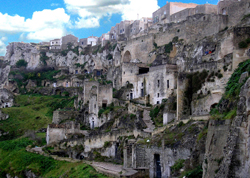
I SASSI DI MATERA
: Ancient dwellings carved into the rock characterize the city of Matera. Their sight takes you back in time, to a rural life far from today's comforts. A distinctive landscape, where the "sassi" (stones) seem to pile up one upon another. A unique spectacle, it has prompted UNESCO to place the Sassi under its aegis.
 BARI: Seen from above, Bari resembles a right hand, palm facing north and thumb raised. The first finger is the old city, nestled on a strip of land jutting into the Adriatic, protected by a high wall and the Swabian fortress. This Frederick II manor house was transformed by Duchess Isabella of Aragon and her daughter Bona Sforza into the "castle of women": a luxurious residence frequented by artists, writers, and scientists seduced by the charm of the two ladies and the lavish court life. The capital of Puglia is also an open hand to the East, a forerunner of trade with the entire Mediterranean, relationships that are developed every September with the Fiera del Levante. The palm is thus a geometric checkerboard of streets bordered by Corso Vittorio Emanuele, pressing against the medieval core of elegant, compact, and square buildings: this is the Murat district, commissioned in 1813 by Joachim Murat, King of Naples and Napoleon's brother-in-law. Within this "nineteenth-century curtain" stand public buildings such as the Ateneo, home to the university and archaeological museum, in Piazza Umberto I; the neoclassical Palazzo della Camera di Commercio, on Corso Cavour; and a splendid trio of historic theaters: the prestigious Petruzzelli, on Corso Cavour; the Politeama Margherita, in Art Nouveau style overlooking the Old Port, once a celebrated temple of variety; and the neoclassical Teatro Comunale, named after the Bari composer Niccolò Piccini and nestled between the two more sober wings of the City Hall, in Piazza Libertà. Opposite the Piccini is the Palazzo del Governo, converted from a former Dominican convent.
 FASANO: In the heart of Puglia, among farmhouses, trulli caves, and fortified farmhouses, in an atmosphere steeped in memories and historical evidence, the ZOOSAFARI of Fasano, the largest leisure complex in central and southern Italy, presents its offer to all those interested.
FASANOLANDIA
:The city of entertainment, in addition to the beautiful animal theater with seals and dolphins, offers twenty of the most modern and exciting attractions.
Every care is taken to ensure impeccable hospitality, safety, and hygiene, with particular attention to our many disabled guests.
 CASTEL DEL MONTE: Solitary and captivating on a hilltop in the Murge mountains, near Andria, Castel del Monte is certainly a must-see. It is an enigmatic and fascinating manor, more like a splendid residence, traditionally attributed to Frederick II of Swabia. Famous not so much for the emperor's actual residence, but rather for its evocative power rooted in the collective imagination, the castle's interior revolves around the number eight: its octagonal shape, eight towers framing it, and eight internal rooms on both the ground and upper floors. From a more concrete perspective, the castle bears witness—despite the plundering and damage it has suffered—to a cultural and artistic climate bridging the Romanesque tradition and the innovations of transalpine Gothic architecture, constantly engaged with a classical sense of balance and restraint.
 CASTELLO DI BARLETTA:One of the most important fortified outposts in the Kingdom, Barletta likely had its castle built under the Normans; Frederick II of Swabia, who is traditionally credited with the regular layout that has survived to this day, is said to have designed it, although the current overall layout dates back to the work carried out under Charles V in the 16th century. Barletta is also known as the City of the Challenge. Every year, in the first half of September, Barletta, and especially its historic center, comes alive with characters from a bygone era: ladies and knights in 16th-century costumes, heralds on horseback and flag-wavers, and fully armed soldiers wander through the Cantina della Sfida, the Cathedral, and the Castle, or parade amidst large Spanish banners and multicolored shields. The key moments of the entire event remain unchanged after so many centuries: the reading of the challenge poster, the investiture and oath of the 13 Italian knights, and the presentation to the public.
These are the moments that lead up, in a climate of growing tension, to the key moment of the event: THE CHIVALERIE CHALLENGE.
 CASTELLO SVEVO DI BARI: The original core of Bari Castle dates back to the Norman-Swabian era and is identified with the current internal quadrangular wall with corner and intermediate towers.
During the destruction of Bari in 1156 by William the Bad, the castle, founded by the Normans themselves, also suffered considerable damage. Around 1233, Frederick II restored it, enhancing its residential and representative appearance through, among other things, the construction of a monumental portal and a portico along the perimeter of the internal courtyard.
At the center of the portal's sculpted archivolt is an imperial eagle clutching a grip in its talons.
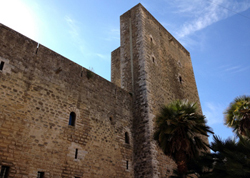
CASTELLO SVEVO DI GIOIA DEL COLLE
: inside the town, the central Piazza dei Martiri is dominated by the Castle founded by Riccardo Siniscalco and rebuilt by the Swabian Emperor Frederick I around 1230.
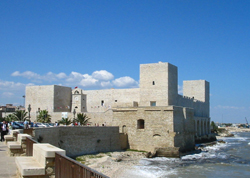
CASTELLO SVEVO DI TRANI
: An extraordinary and silent dialogue links Trani's cathedral and castle, buildings built on the sea at the edge of the old city. Natural defense needs, but above all, control, dictated the choice of a marginal location for the castle; it was founded by Frederick II of Swabia in 1230 and completed within three years, although fortification work continued until 1249.
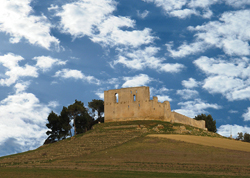
DOMUS FEDERICIANA DI GRAVINA:
Far from the battlefields and immediate defense needs, Frederick II of Swabia carved out some personal spaces for himself, veritable islands of leisure and relaxation, building residential homes that bore the name and ownership of the castle, while concealing the comforts and amenities worthy of a palace. The landscape played a fundamental role, which needed to be pleasant, wooded, and abundant in water to blend harmoniously with the emperor's vocation as a domus solaciorun.
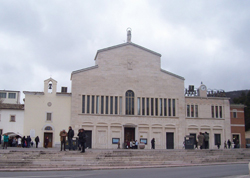
SAN GIOVANNI ROTONDO
: The town's name derives from the Rotonda, a circular baptistery that until 1006 (the year the town was founded) appears to have been a temple of Janus. Next come the 14th-century churches of Sant'Onofrio and Sant'Orsola. At the Capuchin convent, you can visit the places where the Holy Padre Pio lived and worked: the old church and the new church, both dedicated to Santa Maria delle Grazie, the tomb, the cell, and the Crucifix of the Stigmata. The brand new church designed by architect Renzo Piano is also worth a visit.
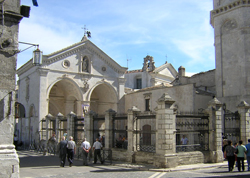
MONTE SANT'ANGELO
: In the town, you can admire the ancient Grotto/Sanctuary dedicated to the Archangel Michael, founded around 490 by the Bishop of Siponto, Lorenzo Maiorano. It is rich in works of art, including a Romanesque portal with bronze shutters. The apse of the adjacent church of San Pietro leads to the famous tomb of Rotari. Also noteworthy are the Romanesque church of Santa Maria Maggiore and the medieval district known as "Junno."
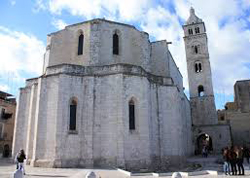
BARLETTA
: The Cathedral, built in 1140, has Romanesque-Gothic architecture and a 13th-century bell tower. The Church of the Holy Sepulchre dates back to the 12th century and is in Burgundian-Gothic style; its Baroque façade retains a pointed door.
 ANDRIA: Built in the Middle Ages but later remodeled, the Domo has a large crypt with an apse from the 9th-10th centuries. The church of San Domenico, with its tall Baroque bell tower, houses a Madonna and Child (a wooden sculpture from the 16th century) and a bust of Francesco II, Duke of Andria, by Francesco Laurana. Next to it are the remains of a 14th-century Gothic cloister. Santa Maria dei Miracoli (two kilometers from the center), built in the 16th-17th centuries over a Brazilian cave, has a beautiful wooden ceiling.
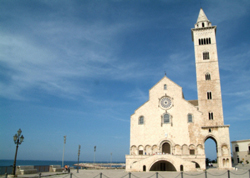
TRANI
: You can visit the Romanesque cathedral with its famous bronze portal, built between the 12th and 13th centuries and featuring a very tall spire-tower. The Church of Ognissanti (12th century) is the only example of a Romanesque temple with a double portico. Other examples of the Romanesque style include the Church of San Francesco, the Church of San Giacomo, the Castle of Frederick II, and the Abbey of Santa Maria della Colonna.
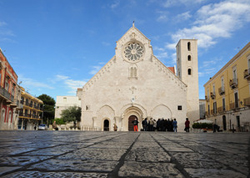
RUVO DI PUGLIA
: The Cathedral, built on early Christian and Roman ruins and completed in 1237, is one of the most beautiful in Puglia.
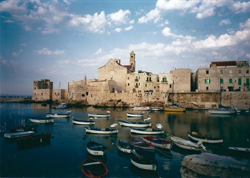
GIOVINAZZO
: The Cathedral, consecrated in 1283, has a Baroque interior, with a crypt flanked by Romanesque columns. The small church of the Holy Spirit dates back to the 14th century. On the left wall of the presbytery of the church of San Domenico is a San Felice painted in 1542 by Lorenzo Lotto.
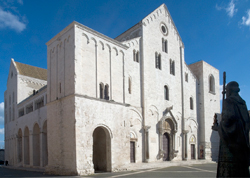
BARI: The Basilica of Saint Nicholas, patron saint of Bari, was built in Apulian Gothic style within the court of Catalan, the Byzantine official of the Eastern Empire of Apulia between the 10th and 12th centuries. Saint Nicholas is among the most venerated saints on the planet: he is popular in the Greek and Slavic East and even in the Anglo-Saxon and Scandinavian worlds where, having cast off his chasuble and tiara and donned the secular guise of Father Christmas, he, the protector of children, nicknamed Santa Claus, brings gifts to children across the globe on December 6th each year. In the Basilica of Saint Nicholas, to the left of the altar housing the saint's relics, a chapel has existed since 1969 where masses are celebrated according to the Eastern liturgy.
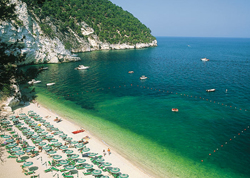
IL GARGANO
:Gargano is a land to savor, unique and inimitable thanks to its intertwined beauty, creating unique natural contrasts where natural landscapes alternate with man-made ones, with almond trees, olive trees, citrus trees, dry-stone walls, farmhouses, and prickly pears. All this in a natural setting where the blue sea caresses a stunning white coastline dotted with caves and sea stacks; where the green of the olive trees nestles against the brilliant green of the pine forests and Mediterranean scrub.
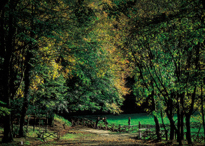
FORESTA UMBRA
: After the stunning Gargano, you'll enchantingly pass through typically mountainous landscapes rich in forests, where columnar beech and Turkey oak trees give life to the majestic Umbra Forest, the heart of Gargano National Park. Its medieval historic centers are picturesque and evocative, filled with castles and ancient monasteries.
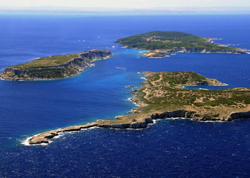
ISOLE TREMITI
: San Domino, San Nicola, and Capraia are the names of the islands in the tiny Tremiti archipelago, just 22 km off the coast of Gargano. A transparent sea with crystal-clear seabeds teeming with unexpected marine life, it's one of Puglia's most popular tourist destinations. The largest island is San Domino, largely covered by a lush Aleppo pine forest and its coastline dotted with caves and natural arches.

